
Valencia hosts the Innovation@schools Project of EIT Cross-KIC Education
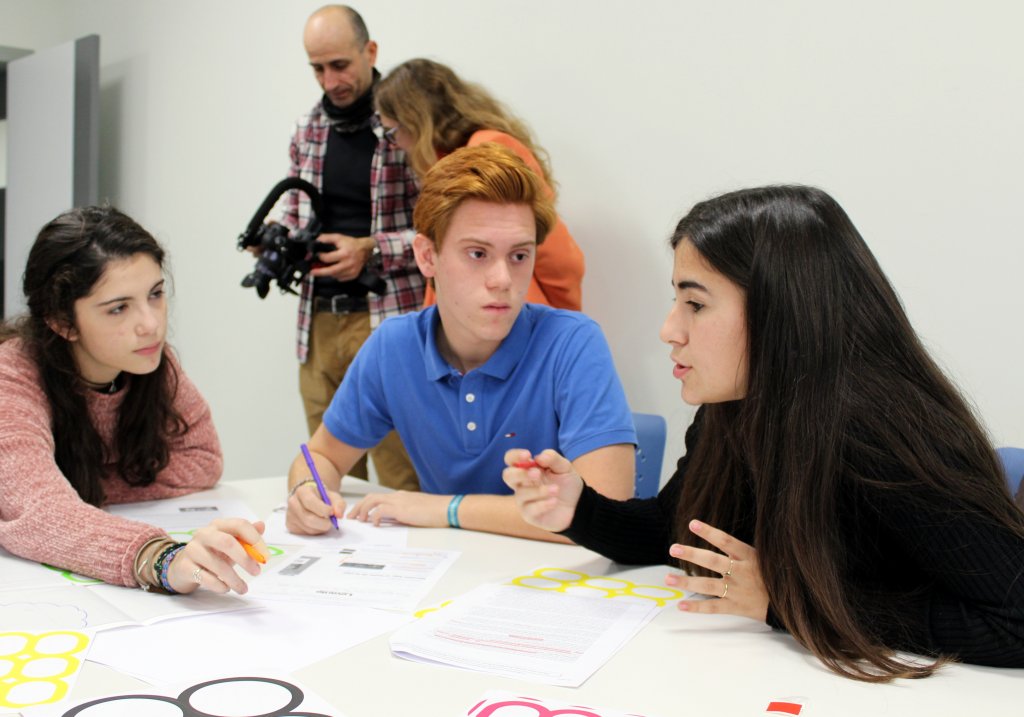

The innovation@schools project is one of the first projects to be developed within the Cross-KIC framework of the innovation and knowledge communities of the EIT (European Institute of Innovation & Technology). This innovative project seeks to adapt the methodologies developed by Climate KIC in its professional education programs for high school and high school students, to promote entrepreneurship and innovation skills in young people.
This initiative involves Climate KIC and EIT Raw materials, as well as Innoenergy as an observer. The consortium is made up of four countries, England, Switzerland, Italy and Spain, where Dutch partners act as observers.
This methodology, developed and shaped by the Transition Hub team, is known as Visual Toolbox and has been applied in programmes such as Pioneers, Journey or Catalyst. The methodology aims to offer tools to develop and deepen the different phases of the innovation process, including situation analysis, ideation and implementation planning.
This methodological tool has been adapted to be used by high school teachers to encourage innovation and entrepreneurship among their students. To this end, a first pilot with teachers in Italy has been carried out, and this week is the first time that the pilot has been made with students in Spain, specifically in one of the Valencian educational centres of reference, the Mas Camarena. This methodology has been applied in this centre together with Polibienestar, an institute of the University of Valencia, partner of Climate KIC Spain. Circular economy was the concept introduced, one of the key and common themes for the different KICs participating in the project.
These kind of projects, and the developed tools, can help the educational community to solve problems through co-creation and ideation, and teachers can adapt their content to these tools to change the way they learn and teach.
From the Transition Hub unit, Cristian Matti, Knowledge & Learning Manager, has highlighted the potential of these tools, their scalability and especially the subsequent treatment of the information obtained in the different dynamics for decision making.